Menu
Common Tree Planting Mistakes to Avoid for Healthier Trees
Tree Planting Cliffside Park
Successful tree planting requires more than selecting attractive specimens and digging holes. At Tree Pros Cliffside Park, we’ve observed how simple mistakes during the planting process can lead to years of problems, from declining trees near Anderson Avenue to failed plantings in neighborhoods surrounding Memorial Park. Understanding common tree planting errors helps ensure your investment provides decades of beauty and value.
Planting at Improper Depth
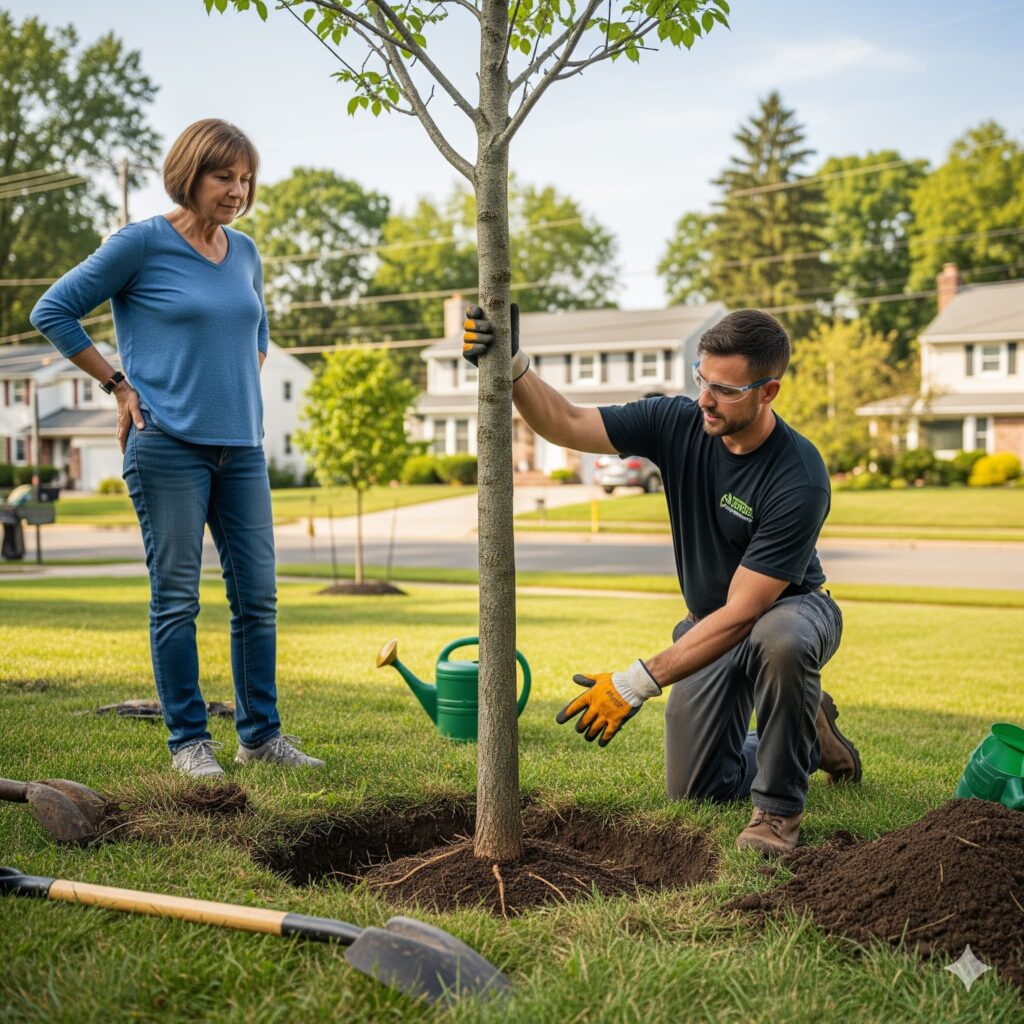
Inadequate planting at the wrong depth is probably the most common, and also the most detrimental, error that will negatively impact the long-term tree health. A study found that more than 90% of trees planted by professionals were planted too deeply, with the root flare buried below the soil or mulch. Inadequate planting causes an environment that leads to root suffocation, trunk decay, and ultimately premature death of the tree.
The root flare is the part of the tree above the major roots where the trunk grows wider and must be visible above the soil surface. When the root flare is buried, the trunk tissue that was exposed to air begins to experience constant moisture, and it creates the perfect environment for fungal diseases and bacterial infections to thrive. Many properties in Cliffside Park’s hilly regions contain examples of properly and improperly planted trees, with the properly planted trees thriving and the improperly planted trees experiencing decline in their health.
Visual indicators of improper planting at the wrong depth of trees include:
- A tree appears to be emerging from the soil like a fence post, with no visible trunk flare or buttress roots.
- A properly planted tree shows a wide trunk flare at ground level, and the major roots are easily visible just below the soil surface.
These differences become more apparent as trees grow and develop their typical root spreads.
Container-grown trees or B&B (balled & burlapped) from nurseries often come with excess soil that covers the root flare. Removing this excess soil before planting prevents the creation of the same buried condition in your landscape as existed in the nursery.
Incorrect planting location is another common mistake that results in long-term maintenance issues and reduces the tree’s overall potential throughout its life span. Trees that are planted too close to buildings will need to be constantly pruned to avoid damaging the building, and trees located under utility lines will be severely pruned repeatedly, which will significantly reduce their health and appearance. Mature size considerations are often neglected when trees are initially planted, but they become very important factors in determining whether the tree will be successful or not.
Because of the variety of terrains and utility infrastructure in Cliffside Park, proper site assessment is needed before planting occurs. Some properties near Palisades Interstate Park may have different soil compositions and drainage characteristics than some properties near the Hudson River, and therefore, different species and planting methods should be used.
Conflicts with Underground Utilities
While underground utilities pose a significant risk of injury to people who are installing new landscaping, they can also cause problems once a tree’s roots begin to develop. Before starting any type of excavation-related landscaping activity, contact Dig Safe (811) so you can locate all buried lines to minimize the chance of injury to yourself or others. At least 12 feet of distance is required between major underground utilities and large trees to prevent future root development conflicts, and to allow for easy access to repair the utility lines if needed.
Overhead Power Lines
Overhead power lines create problems with ongoing maintenance when large trees begin to encroach upon them. The residential areas of Cliffside Park near Grantwood Park show how important it is to select the right-sized tree for the available space and overhead utility clearance needs.
Insufficient Hole Size and Poor Holes
Holes that are too small for the root ball will limit the ability of the roots to grow and create an unstable planting situation. Ideal planting holes are 2 to 3 times larger in diameter than the root ball, and are the correct depth to position the root flare correctly. Wider holes with loose soil will help facilitate rapid root growth and improve the tree’s long-term stability.
Root penetration into the surrounding soil is limited when compacted surfaces are formed by digging tools in clay soils. Soil compaction will be broken down, and the backfill material loosened to enable the roots to expand beyond the original planting area, and access water and nutrients throughout the entire root zone.
Use of Incorrect Backfill Materials or Too Many Amendments
Use of incorrect backfill materials or using excessive soil amendments can create drainage problems and inhibit root development. The best backfill material is the original soil with 10 to 20 percent added compost to provide the tree with familiar growing conditions, improve the quality of the soil, and increase the amount of nutrients available to the tree.
Heavy amendments or drastically changed soil conditions within the planting hole will result in root circling and promote the roots to grow outward and upward into native soil conditions. This technique will produce a strong, healthy root system that will support the mature growth of the tree.
Excessive Watering and Common Watering Mistakes
Overwatering has killed more newly planted trees than drought stress has, especially in the clay soils common throughout Bergen County. Excessive watering results in low-oxygen conditions that kill roots and foster fungal diseases and root rot. Understanding proper watering techniques will eliminate the common problems and ensure enough moisture to support the establishment of a new tree.
Establishing a proper watering schedule for a newly planted tree depends on soil type, weather, and the tree’s species. Frequent light watering will encourage the development of shallow roots, whereas less frequent, deeper watering will foster drought resistance and encourage the growth of the roots.
Adjustment of Seasonal Watering Techniques
Newly planted trees require different watering techniques depending on the time of year and the weather, but there is one season that is often overlooked: winter. Evergreen species and trees that were planted in the fall of the previous growing season need to receive supplemental irrigation during the winter months in order to survive until the next growing season. Because of the varied elevations in Cliffside Park, each elevation will have its own unique microclimate and therefore require a customized watering regimen.
Monitoring soil moisture at multiple depths will help determine if irrigation is needed. Tools such as a soil probe or long screwdriver can be used to check the moisture content of the soil, and avoid either drought stress or waterlogged conditions that can harm the roots.
Volcano Mulching and Other Types of Improper Mulching
Improper mulching is a problem that is commonly overlooked, yet very evident in residential landscaping. Volcano mulching is a method of applying mulch that is similar to planting too deeply, because it traps moisture in the soil, creates a habitat for insects and diseases, and traps moisture in the soil. Proper mulching techniques will provide benefits to the trees without creating other problems.
To apply mulch correctly, it must be applied at a thickness of 2 to 3 inches and in a circular pattern around the tree, extending out to the edge of the canopy (drip line). There should be at least 6 to 8 inches of clear space between the mulch and the trunk of the tree. This type of mulching will retain soil moisture, suppress weed growth, and regulate soil temperature, while providing good airflow around the root flare.
Types of Mulch
There are many types of organic mulches that can be used in residential landscaping, such as wood chips or shredded bark. Organic mulches will eventually break down and contribute to the improvement of the soil structure and fertility, while retaining moisture and regulating soil temperature. Fine-textured mulches should be avoided because they will create a non-porous layer on top of the soil, which will interfere with water infiltration and maintain unhealthy soil conditions.
Many properties in residential areas near Zalewski Park demonstrate the positive effects of well-applied mulch on the growth and health of trees compared to trees that received insufficient or excessive amounts of mulch.
Failure to Select the Correct Species for the Site Conditions
Selecting a tree species that matches the site conditions will eliminate many maintenance problems and ensure optimal performance throughout the tree’s life cycle. For example, sun-loving trees that are planted in shaded areas will exhibit weak growth and will be more susceptible to disease. Moisture-loving trees that are planted in dry areas will require continuous watering and care.
Because of the diversity of growing conditions throughout Cliffside Park, ranging from well-drained hillside areas to low areas that periodically flood, species selection should be made based on the specific conditions of the site, rather than just aesthetic appeal. Typically, native and adapted species will perform better than exotic species and will require more specialized care.
Incompatibility of Soils
Soil pH, drainage, and nutrient availability can have a greater effect on tree performance than many homeowners realize. Before planting, conducting a soil test will help identify the conditions that will require amendments or indicate the need for alternative species that are compatible with the existing soil conditions.
Trees that are being grown in soil that is incompatible with their requirements will be more susceptible to pest and disease problems, and will require increased maintenance inputs throughout their life cycle. Matching tree species to their site conditions will eliminate many potential problems and decrease the long-term care of the tree.
Mistakes in Timing and Seasonal Planting
Planting during the wrong season will stress the tree and decrease the establishment success rate of the tree. Summer planting presents the greatest heat and drought stress to the tree when the root system of the tree is still developing and unable to meet the moisture demands of the tree. Late fall planting in the northern climate may not provide the necessary time for the roots of the tree to develop before the ground freezes.
Optimal planting times for trees in our region occur in the spring and fall when the temperatures and moisture are moderate and conducive to successful establishment. Spring planting allows the tree to fully develop its growth through the remainder of the growing season, while fall planting takes advantage of the tree’s ability to continue to develop its roots during the cooler months.
Scheduling Follow-Up Maintenance After Planting
Tree planting involves much more than simply installing the tree. Successful tree planting involves performing the correct maintenance activities during the establishment phase. The first year after planting involves the establishment of the tree’s root system, the promotion of new growth, and the protection of the tree from pest and disease problems. During this period, it is essential to monitor and adjust the maintenance activities as necessary to accommodate the tree’s responses to the environmental conditions and the changing requirements of the tree.
Obtaining Professional Guidance During Establishment
Professional guidance during the establishment period will help identify potential problems early on and assist in the implementation of the proper maintenance techniques to promote healthy development of the tree. By monitoring the tree’s progress, adjustments to the maintenance activities can be made as necessary to optimize the tree’s growth and health.
Success With Long-term Tree Planting
Avoiding common mistakes in tree planting establishes a solid foundation for the healthy growth and development of the tree for decades to come. Effective tree planting techniques combined with the selection of the correct species and proper site preparation provide a stable environment that supports optimal tree development throughout the changing seasons and environmental conditions of the area.
If you are considering new plantings for your property in Cliffside Park, consulting with a professional arborist will help identify potential problems before they develop and will ensure that the trees are installed correctly. The professional services offered by Arbor Masters will provide a complete solution to your tree planting needs, utilizing technical knowledge of the specific tree planting techniques and understanding of the local growing conditions to create a healthy, thriving landscape for the benefit of our community.