Menu
Preventing the Spread of Tree Disease in Your Yard
Tree Disease Treatment Cliffside Park
Tree disease prevention requires proactive management and understanding of the conditions that promote pathogen development. At Tree Pros Cliffside Park, we’ve observed how quickly diseases can spread through residential landscapes, from the wooded areas near Palisades Interstate Park to the established neighborhoods around Grantwood Park. Effective tree disease treatment begins with prevention strategies that protect your entire landscape investment.
Understanding Common Tree Diseases in Cliffside Park
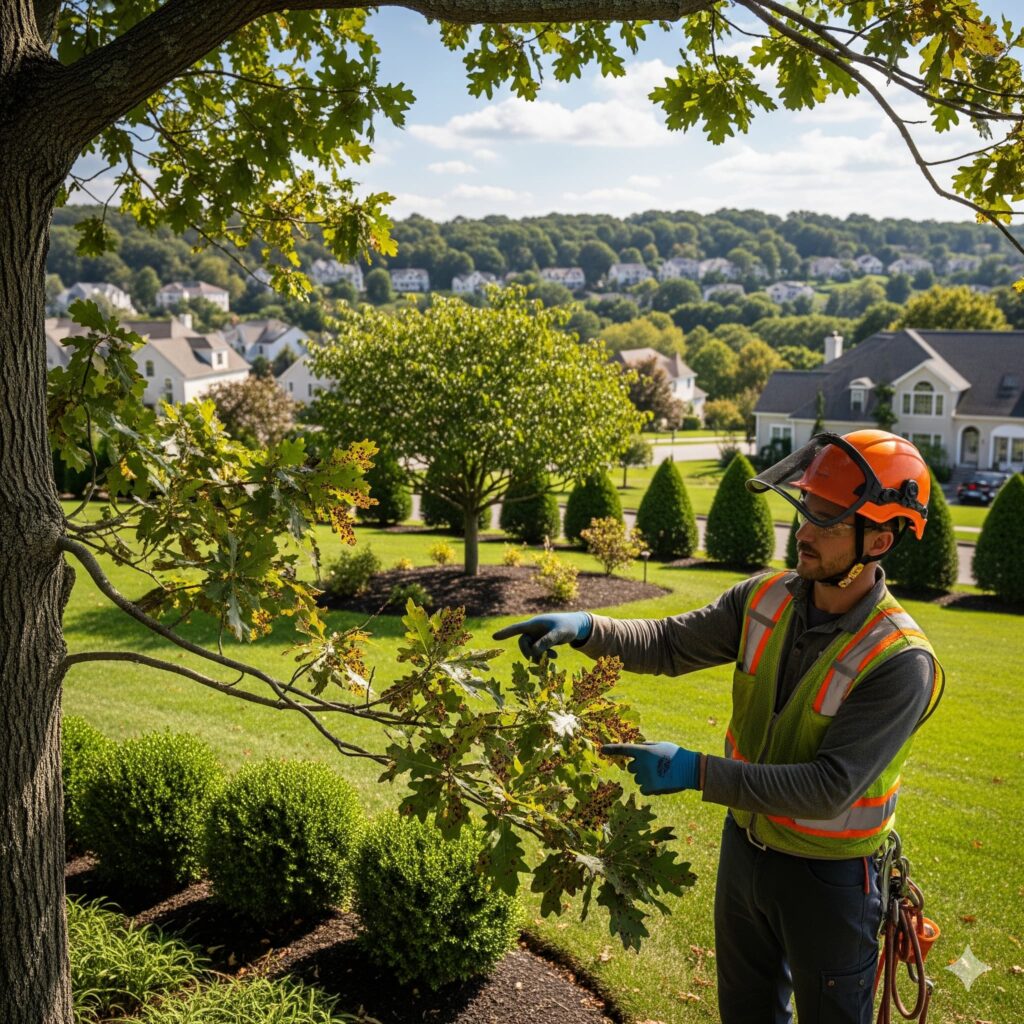
Tree disease is one of the primary threats to tree longevity in Cliffside Park. As a result of Bergen County’s climate and urban environment, many serious tree diseases are well-established in this area. One of the most significant tree diseases currently impacting American beech (Fagus grandifolia) trees in residential areas near Memorial Park and elsewhere in Cliffside Park is beech leaf disease. First confirmed in the area in 2020, beech leaf disease is a devastating, microscopic nematode-based disease that causes tree death within 2-7 years if untreated.
Another significant threat to elm (Ulmus spp.) trees in Cliffside Park is Dutch elm disease. It spreads through the activity of bark beetles and roots connecting nearby trees, blocking the flow of water through the tree by killing the water-conducting vessels, resulting in a rapid decline and eventual death of the tree. In addition to Dutch elm disease, oak wilt (Ophiostoma ulmi) is a major disease concern for the many red oak (Quercus rubra) trees that grow in residential neighborhoods around Anderson Avenue.
New Tree Diseases
Anthracnose (Gnomonia leptostachya) infects numerous types of trees, including dogwood (Cornus spp.), oak (Quercus spp.), and sycamore (Platanus occidentalis), and thrives in the high humidity found in NJ spring weather. Crabapples (Malus spp.) are the target of apple scab (Venturia inaequalis), which is commonly used in residential landscaping. Cedar-apple rust (Hymenoscyphus pseudoalbidus) infects both cedar (Juniperus spp.) and apple (Malus spp.), and is particularly difficult to manage in urban forest ecosystems because it completes its life cycle using both host species. Early detection of all tree diseases is a key factor in effectively managing them. Any unusual coloration on leaves, premature leaf fall, wilting, canker formation, or irregular growth patterns should be assessed by a certified arborist promptly to prevent further spread of disease on your property.
Selecting Healthy Plants
Selecting plants that have been developed to be resistant to disease is the best way to ensure long-term tree health. While planting new trees in areas such as Zalewski Park or along residential streets, selecting a cultivar that has been bred to resist many of the common fungal diseases will reduce future management requirements. There are several tree species native to New Jersey that are naturally resistant to some of the most common tree diseases. These include American holly (Ilex opaca), red oak (Quercus rubra), and sugar maple (Acer saccharum).
Location Matters
The location where a tree is planted also impacts its disease susceptibility. Trees planted in areas with good drainage, adequate sunlight, and enough space for air to circulate will be subjected to less stress and thus have a better chance of developing disease resistance than those in poor sites. The varied topography throughout Cliffside Park means that each property will need to be approached differently depending upon the site-specific conditions.
Spacing Between Trees
Trees that are too close together create humid microclimates that are conducive to the growth of fungi. Air movement is reduced when trees are crowded, which reduces the time required for leaves to dry after rain or irrigation, and makes it easier for diseases to establish themselves. Proper spacing between trees and between trees and structures will eliminate the conditions that foster disease development, and allow each tree to receive adequate amounts of water and nutrients for healthy growth.
Understand Mature Tree Sizes
Knowing how large a mature tree will grow can help you avoid problems down the road when the trees are fully grown. The amount of space needed for proper tree development can vary greatly between tree species, which is evident in the varying size differences between trees planted in residential areas near School #6 and in other established areas of Cliffside Park.
Managing Water for Disease Prevention
Proper watering techniques are an essential part of a successful disease prevention strategy. The overhead watering technique used by many homeowners creates ideal conditions for many diseases by keeping foliage wet for extended periods. Using deep, infrequent watering techniques will promote healthy root development and keep leaves dry, which discourages pathogen establishment.
Topographic Variability
Because Cliffside Park is composed of a variety of terrains, homeowners located on slopes near the Hudson River cliffs will require special irrigation techniques to prevent erosion and runoff while ensuring adequate soil moisture penetration.
Timing of Irrigation
To minimize the opportunity for disease to develop, water your trees early in the day so that foliage dries quickly. Do not irrigate in the late afternoon or evening, as this creates conditions that are ideal for the growth of many pathogens.
Types of Irrigation Systems
Two main types of irrigation systems areused to apply water to trees: drip irrigation and soaker hose systems. Drip irrigation delivers water directly to the root zone of the tree, thus avoiding wetting the foliage. Both of these types of systems are especially useful for properties containing multiple trees and mature landscapes that require consistent moisture levels without promoting disease conditions.
Benefits of Mulch
Mulch offers a number of benefits that will aid in preventing diseases. Mulch retains moisture in the soil, regulates soil temperatures, and prevents soil-borne pathogens from splashing onto lower branches during rainfall. In addition, organic mulches improve soil structure and fertility as they break down.
Using Mulch Correctly
When applying mulch, there are a couple of considerations to make. Mulch should be maintained at the correct depth, typically 2-3 inches, and kept away from the trunk of the tree to prevent creating a favorable condition for pests and disease to occur. Applying mulch too thickly can cause problems, but applying the recommended 2-3 inch layer up to the drip line will provide maximum benefits without creating excessive mulch-related problems.
Pruning for Disease Prevention
Strategic pruning can remove diseased tissues from the rest of the tree and enhance air movement through the canopy of the tree, thereby making the environment less suitable for the growth of fungi. Different tree species require different times of year to prune; oak trees must be pruned during their dormant season to prevent attracting beetles that spread oak wilt disease. Regardless of the time of year, always clean and disinfect pruning tools between trees to prevent the mechanical transfer of pathogens from diseased trees to healthy trees.
Benefits of Structural Pruning
In addition to enhancing the environment for the growth of healthy trees by increasing the amount of light and air moving through the canopy of the tree, structural pruning also enhances the structural integrity of the tree by reducing the amount of force exerted by winds that can cause damage to branches, and ultimately create wounds for pathogens to enter the tree. Structural tree pruning can also be used to direct the energy of the tree towards producing healthy growth rather than towards producing water sprouts, suckers, or crossing branches that can act as avenues for disease to enter the tree.
Integrated Pest Management (IPM)
An integrated pest management (IPM) approach to controlling tree diseases utilizes a combination of methods, including cultural practices, biological controls, and targeted chemical treatments when necessary. By utilizing multiple methods, IPM minimizes the use of chemical treatments, which can harm non-target organisms, and maintains effective disease suppression throughout the growing season.
Detection Programs
Regular monitoring of your trees for signs of disease can help you detect problems early in the course of the disease. Many diseases can be controlled most effectively when detected early, and regular monitoring can help you identify when to implement preventative measures and when to treat. Professional inspections can identify subtle symptoms of disease before the disease becomes widespread or enters additional trees on your property.
Encouraging Beneficial Organisms
Promoting beneficial insects, birds, and microorganisms in the soil creates natural barriers against diseases caused by harmful organisms. Native plant diversity in landscapes provides habitats for beneficial organisms, while reducing the likelihood of disease problems that favor certain types of disease problems. Protecting beneficial organisms by not using broad-spectrum pesticides will protect the beneficial organisms that help to suppress diseases naturally.
Professional Tree Disease Treatments
If preventative strategies fail to prevent tree disease, professional tree disease treatment is necessary to stop the spread of disease and restore the health of the affected tree. Systemic fungicides can provide effective control for diseases like beech leaf disease and Dutch elm disease if applied correctly by a certified arborist. However, timing is everything, and many diseases require preventative applications before symptoms are visible.
Advancements in Treatment Technologies
Two advanced technologies are being used today to treat tree diseases more efficiently and with less environmental impact. Trunk injection systems inject therapeutic agents directly into the vascular system of the tree, delivering treatment to the source of the problem. Soil treatments can treat root diseases and improve the health of the tree by improving its nutrient uptake and establishing beneficial microorganisms.
Sustainable Landscapes
By incorporating disease prevention principles into landscape designs from the beginning, sustainable landscapes can be created that will protect your investment over the long term. Designing a landscape plan that includes a diverse mix of tree species, implements proper spacing, and incorporates drainage systems that support tree health and prevent disease development will provide long-term protection to your investment. Professionals can assist with developing a customized landscape plan that addresses the specific conditions in your neighborhood and utilizes the varied topography of Cliffside Park to your advantage.